
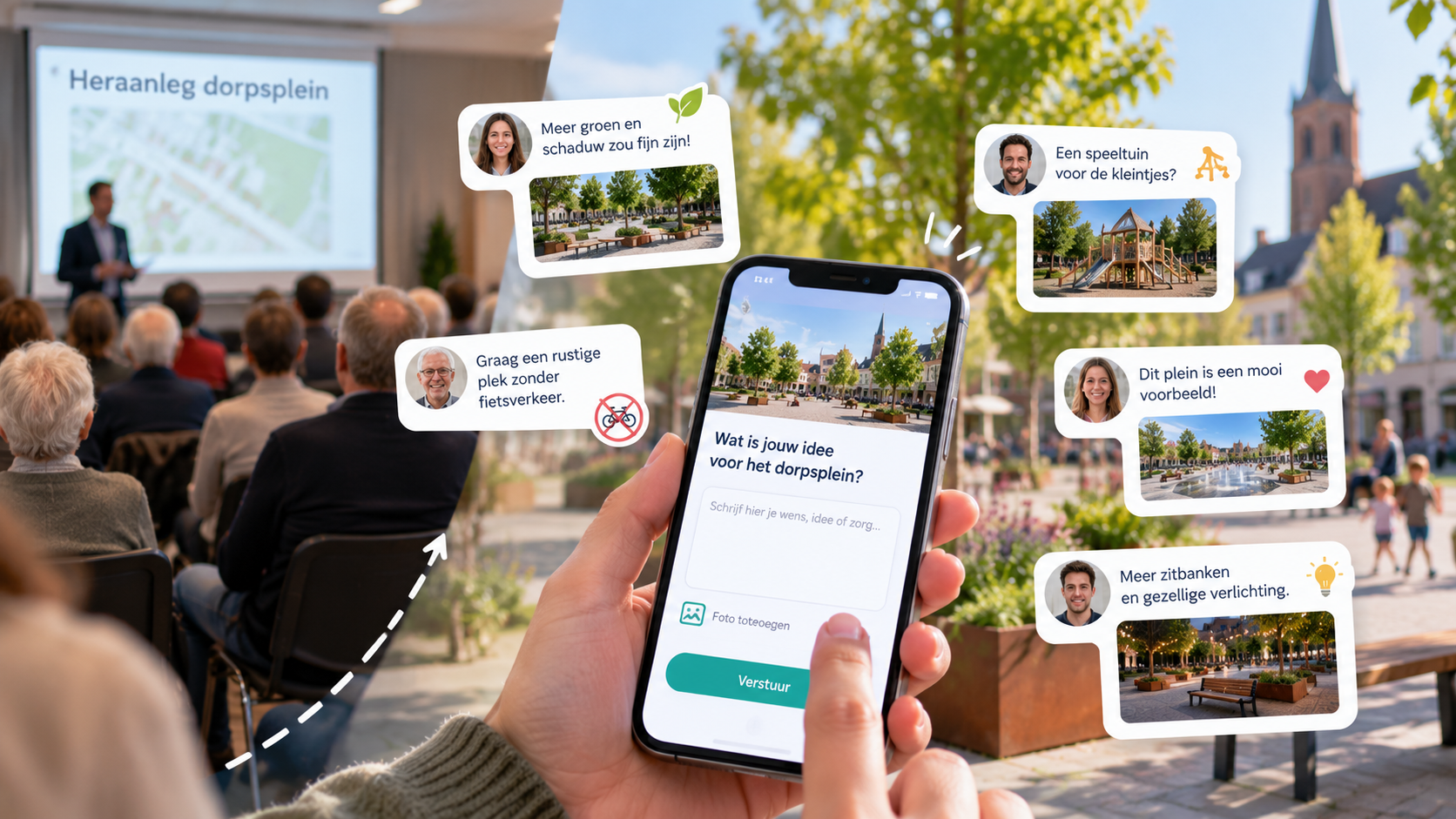
The hundreds of others who do have an opinion, but do not feel like spending an evening at the town hall, remain invisible. That is why more and more participation and spatial planning services look for extra channels to hear that silent majority after all.
A wish page as an accessible extra channel
Wens on Web is used for this as a complement to, not a replacement of, the existing formal participation procedures. Around a concrete project, for example the redesign of a village square, the municipality creates a page where residents can leave a wish, idea or concern in a few minutes. No account, no login code, no long questionnaire: just a text field, as they would for a birthday wish.
What residents can share
Besides text, residents can also add a photo. That opens interesting possibilities: a photo of a similar square in another municipality as inspiration, a photo of the current situation with a mark of what is missing, or simply an image that captures the atmosphere they want to keep or change. That visual input often gives designers a more concrete foothold than a score on a satisfaction scale.
Who this reaches
The low threshold is decisive. Young families who have no time for an evening meeting, people who work, or residents who never feel called to speak at an information evening: those are exactly the groups who do share something through a short online wish. That produces a broader and more diverse picture than a classic participation process alone.
How this fits in a participation trajectory
It is important to stress: this does not replace a legally required public inquiry or official consultation moment. It is an extra, accessible channel that runs alongside the existing procedure, and is mainly meant to collect additional, informal input from a wider group of residents.
Processing the results
After the collection period the municipality bundles all wishes into an overview: a series of recurring themes, striking ideas, and concrete examples that can inspire the designers or the study office. That overview can be included in the participation report, as a complement to the results of information evenings and surveys.
An example from practice
When redesigning a village square, a municipality shared the link via its newsletter and social media with the question: "What do you miss on the square today, and what would you like to see there?" Within two weeks dozens of responses came in, from young parents asking for more shade and benches to older residents arguing for a quiet corner without bicycle traffic. Input that would never have reached the table during the classic information evening.